

Industrial Tunnel Freezer: Working Principle, Types and Applications
An industrial tunnel freezer is an essential piece of equipment for food manufacturers that need fast, consistent and continuous freezing. Using a conveyor system and controlled low-temperature airflow, it can freeze seafood, vegetables, meat, poultry, fruits and prepared foods. This guide explains how a tunnel freezer works, its main configurations, key advantages and what to consider before purchasing one.
1. What Is an Industrial Tunnel Freezer?
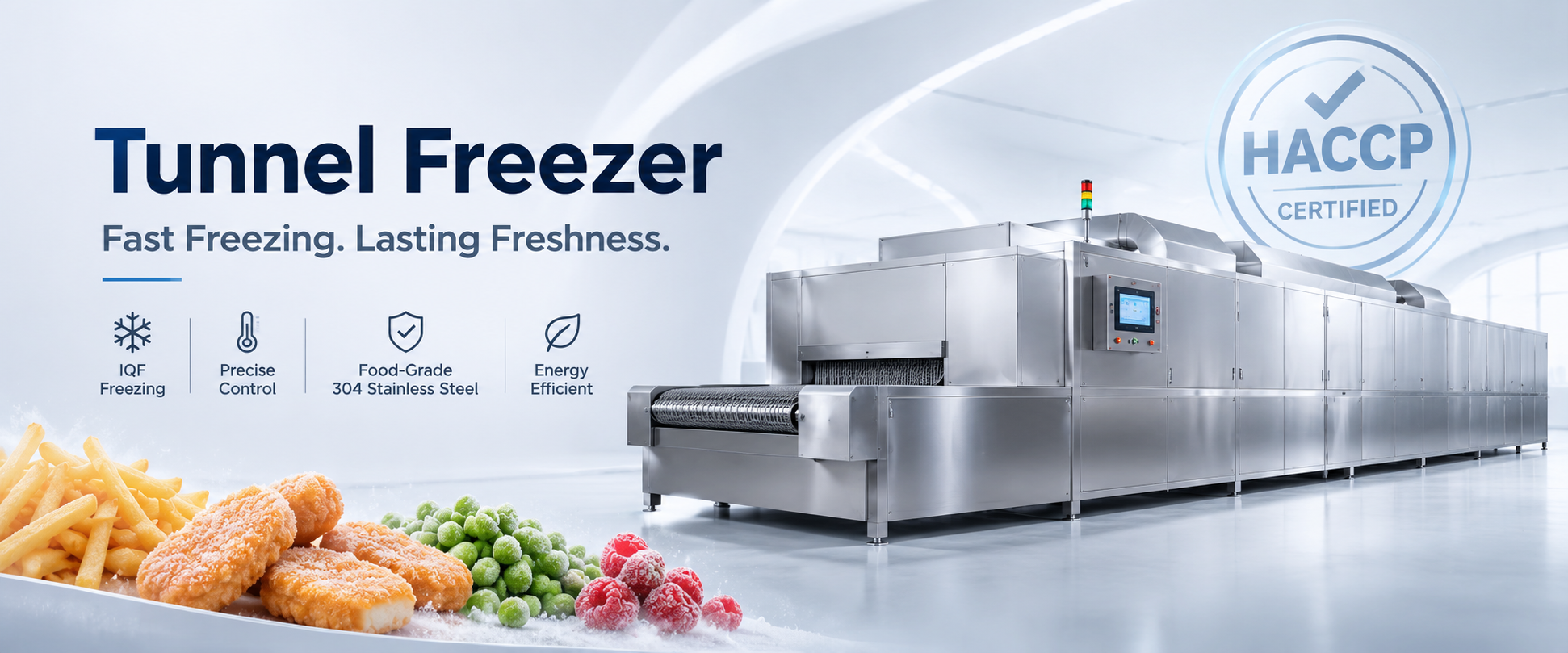
An industrial tunnel freezer is a continuous food-freezing machine designed to lower product temperature as food moves through an insulated freezing chamber. A conveyor belt transports products through the tunnel while a refrigeration system supplies cold air for rapid heat removal.
Unlike batch freezing equipment, a tunnel freezer allows products to enter and leave the freezing chamber continuously. This makes it suitable for food factories with regular production schedules and high processing requirements.
An IQF tunnel freezer is commonly used for individually quick-frozen products. It helps freeze individual pieces separately, reducing product sticking and supporting convenient storage, packaging and distribution.
2. How Does a Tunnel Freezer Work?
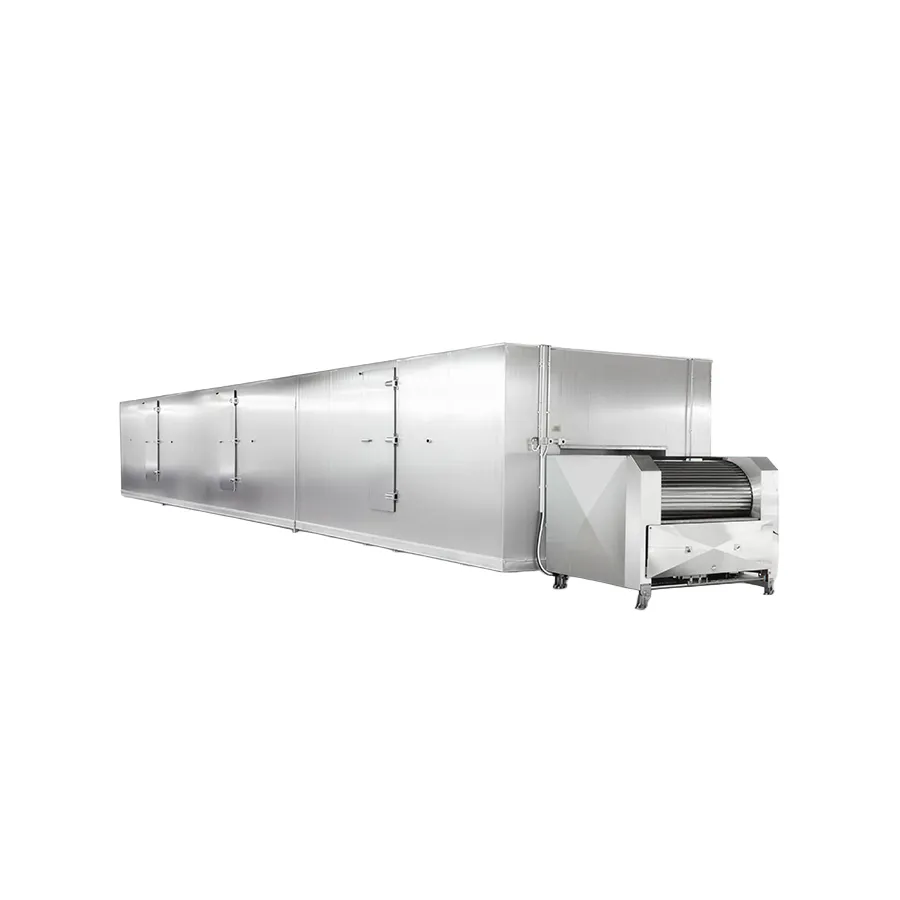
The working principle of a tunnel freezer is based on forced convection heat exchange. Products move through a low-temperature chamber on a conveyor belt. Cold air circulates around the products and continuously removes heat until the required core temperature is reached.
Stage 1: Product Feeding and Pre-Cooling
Fresh or processed food enters the machine through the inlet. Products are distributed across the conveyor belt to support stable feeding and consistent freezing. The initial heat is removed as the food enters the low-temperature environment.
Stage 2: Rapid Freezing
Inside the freezing chamber, fans circulate cold air across the products. Heat is transferred from the food to the circulating air and removed through the refrigeration system. Airflow, belt speed and freezing time work together to achieve the required freezing result.
Stage 3: Product Discharge
Once the product reaches the target temperature, it leaves the tunnel through the outlet. The frozen food can then proceed to weighing, packaging, cold storage or the next stage of production.
3. Main Advantages of an IQF Tunnel Freezer
For food processors, freezing performance is not only about reaching a low temperature. Product quality, production efficiency, operating stability and ease of integration are also important.
Rapid Heat Removal
Forced cold-air circulation removes heat quickly and helps shorten the freezing process compared with slower freezing methods.
Better Product Quality
Rapid freezing helps limit the formation of large ice crystals, supporting food texture, appearance and product quality.
Continuous Production
The conveyor design supports continuous feeding and discharge, making it suitable for integration with upstream and downstream processing equipment.
Flexible Configuration
Belt width, tunnel length, conveyor speed and refrigeration capacity can be selected according to production requirements.
Automatic Control
A PLC control system can coordinate operating parameters and help operators manage the freezing process.
Wide Food Applications
Different configurations can be used for seafood, vegetables, fruit, meat, poultry and various prepared foods.
4. What Products Can an Industrial Tunnel Freezer Process?
Tunnel freezing equipment is used across many food-processing industries. The appropriate conveyor and airflow configuration depends on the product's physical characteristics and processing requirements.
Seafood and Shrimp
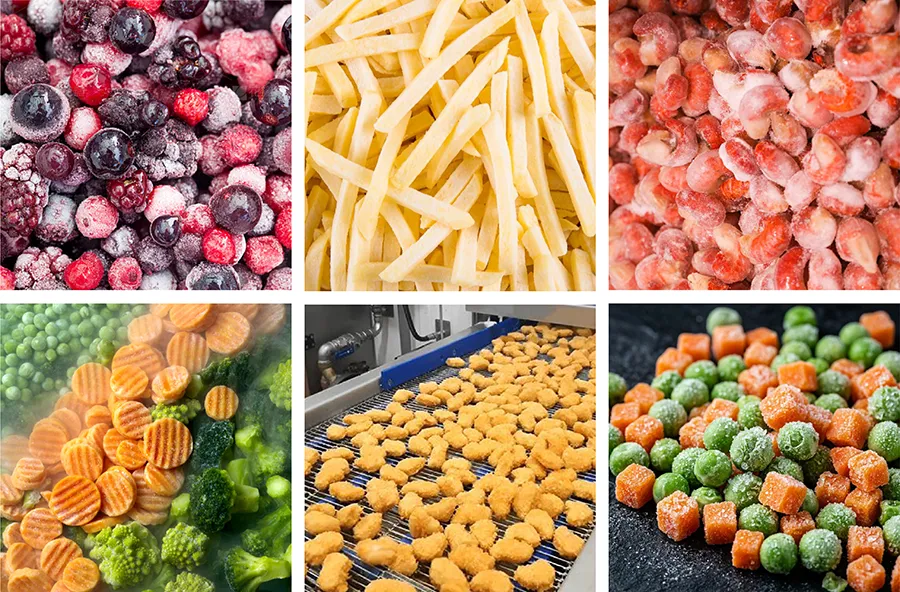
Shrimp, fish fillets, squid and other seafood products can be processed using suitable freezing configurations. Product size, loading thickness and required freezing time should be considered when selecting the system.
Vegetables
Green beans, peas, corn, broccoli, diced carrots and other vegetables are common applications for IQF freezing. Individual quick freezing helps maintain product separation and makes portioning easier.
Fruits and Berries
Strawberries, blueberries, mango pieces and other fruit products can be frozen for further processing, storage or distribution. Airflow and belt loading need to be adjusted to the characteristics of each product.
Meat and Poultry
Meat pieces, chicken products and other poultry products can be frozen in industrial tunnel systems. Product thickness and core-temperature requirements are important factors in process design.
Prepared and Convenience Foods
Dumplings, patties, snacks and other prepared foods may also require continuous freezing before packaging. The conveyor and freezing process should be matched to the product shape and production line.
5. Different Types of Industrial Freezing Equipment
Not every food factory needs the same freezing system. Production capacity, available floor space, product characteristics and freezing time all influence equipment selection.
Conveyor Tunnel Freezer
A conveyor tunnel freezer uses a straight conveyor belt to move products through the freezing chamber. It is suitable for continuous processing and a wide range of food products. Its belt width, tunnel length and operating speed can be configured according to the required output.
Spiral Freezer
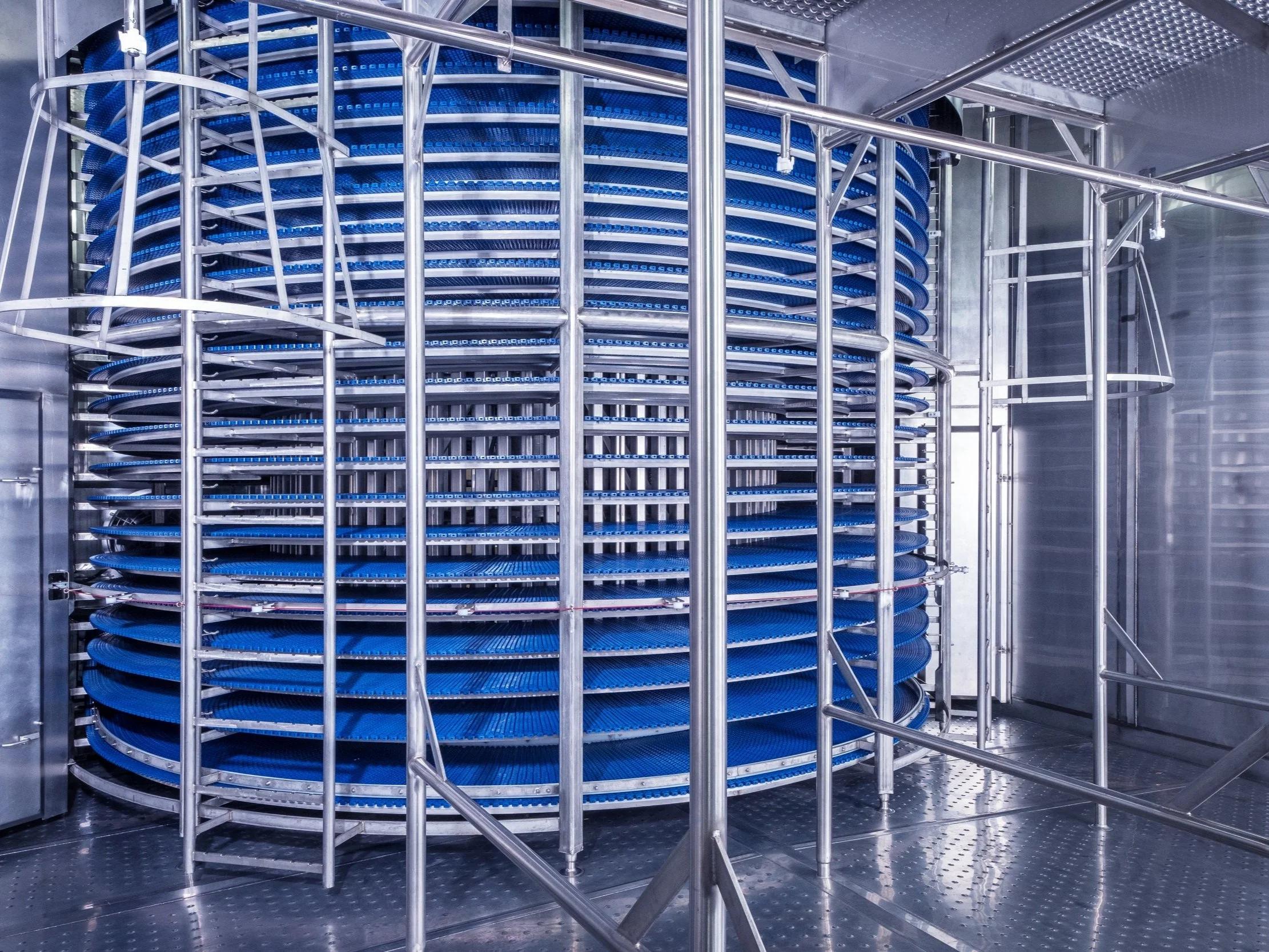
A spiral freezer uses a multi-level spiral conveyor to extend the freezing path within a relatively compact floor area. It is often considered when a factory needs longer freezing time but has limited installation space.
Cabinet or Batch Freezer
A cabinet freezer processes products in batches inside an enclosed chamber. It may be suitable for smaller production volumes, intermittent operation or specific packaged products.
Fluidized Bed Freezer
A fluidized bed freezer uses upward airflow to suspend and separate small food pieces during freezing. It is commonly considered for products such as peas, diced vegetables and certain seafood applications.
6. Tunnel Freezer vs. Spiral Freezer: What Is the Difference?
Both tunnel freezers and spiral freezers are used for continuous industrial freezing, but their conveyor structures and space requirements are different.
| Comparison | Tunnel Freezer | Spiral Freezer |
|---|---|---|
| Conveyor Structure | Straight conveyor belt | Multi-level spiral conveyor |
| Floor Space | Requires a longer installation area | Uses vertical space to reduce floor footprint |
| Freezing Path | Linear transport through the tunnel | Extended path through spiral levels |
| Typical Consideration | Continuous processing and product flow | Longer freezing time in limited space |
| Selection Factors | Product, capacity, belt width and tunnel length | Product, capacity, belt levels and available height |
The best choice depends on the production process rather than equipment type alone. A factory should compare required freezing time, hourly output, product handling and installation conditions before making a decision.
7. Mechanical Refrigeration or Liquid Nitrogen Freezing?
Industrial food freezing systems can use different cooling technologies. Mechanical refrigeration and liquid nitrogen freezing are two distinct approaches.
Mechanical Refrigeration
A mechanical refrigeration system uses components such as a compressor, condenser, expansion device and evaporator. Refrigerant circulates through a closed system, while the evaporator cools the air inside the freezing chamber.
- Suitable for many continuous industrial freezing applications.
- Supports controlled low-temperature operation.
- Can be configured for different production capacities.
- Operating performance depends on refrigeration design and plant conditions.
Liquid Nitrogen Freezing
Liquid nitrogen has a temperature of approximately -196°C. It absorbs heat from food as it evaporates, allowing very rapid cooling. Since nitrogen is supplied and consumed during operation, its availability and consumption cost should be included in the project evaluation.
- Provides very rapid heat removal.
- Does not rely on a conventional compressor-based cooling cycle for the direct freezing medium.
- Requires a reliable liquid nitrogen supply.
- Operating costs depend partly on nitrogen consumption and supply conditions.
The appropriate technology should be selected according to the food product, freezing speed, production scale, utility availability and total operating cost.
8. Important Factors When Choosing a Tunnel Freezer
Selecting an industrial tunnel freezer requires more than comparing equipment prices. The following information helps determine whether a machine can meet the actual production requirements.
1. Product Type and Characteristics
Identify the food to be frozen and provide product photos, dimensions, thickness and physical characteristics. Different foods require different airflow, loading and freezing configurations.
2. Required Production Capacity
Confirm the required output in kilograms per hour or tons per day. Capacity directly affects conveyor dimensions, refrigeration requirements and overall equipment configuration.
3. Inlet and Target Temperatures
The temperature of the product before freezing and the required final core temperature are essential for calculating freezing time and selecting suitable operating parameters.
4. Freezing Time
Different products require different freezing times. Product size, moisture, thickness and loading density should be evaluated before determining conveyor speed and tunnel length.
5. Factory Space and Utilities
Installation space, available height, voltage, frequency, drainage and refrigeration conditions should be confirmed before equipment design.
6. Automation and Production Line Integration
Consider whether the freezer needs to connect with upstream processing, feeding, weighing, packaging or cold-storage equipment. PLC control and conveyor coordination can help improve production management.
- Product name and product photos
- Required hourly production capacity
- Product inlet temperature
- Target product core temperature
- Expected freezing time, if available
- Factory installation dimensions
- Local voltage and frequency
9. Why Choose Foodline for an Industrial Tunnel Freezer?
Foodline provides industrial food-processing equipment and customized freezing solutions for different production requirements. Instead of applying one fixed configuration to every project, equipment selection considers the food product, target capacity, freezing process and factory conditions.
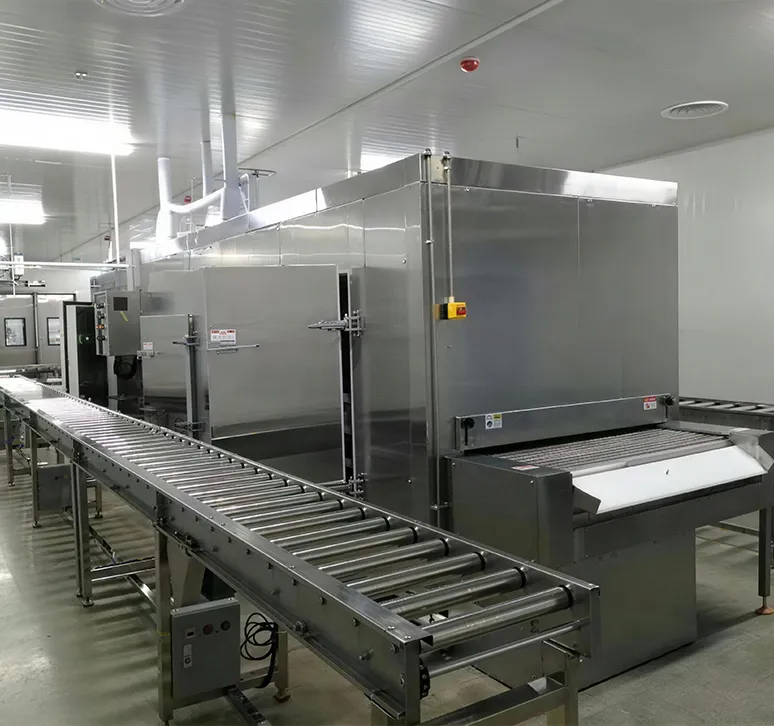
Foodline tunnel freezer solutions can be planned around the following requirements:
- Capacity planning: Reference solutions from 100kg/h to 3t/h.
- Product suitability: Configurations for seafood, vegetables, fruits, meat and prepared foods.
- Conveyor design: Belt dimensions and conveying speed selected according to the product.
- Temperature control: Freezing parameters configured for the required product temperature.
- Automatic operation: PLC control options for process management.
- Food-contact materials: 304 stainless steel mesh belt options.
- Project customization: Equipment layout and configuration based on factory conditions.
Whether you are building a new food processing facility or upgrading an existing production line, providing accurate product and capacity information helps Foodline recommend a more suitable freezing solution.
10. Frequently Asked Questions About Tunnel Freezers
What is the purpose of an industrial tunnel freezer?
An industrial tunnel freezer rapidly lowers food temperature using forced cold-air circulation. It is designed for continuous freezing of products such as seafood, vegetables, meat, poultry and prepared foods.
What is the difference between an IQF freezer and a regular freezer?
IQF stands for Individually Quick Frozen. An IQF freezer is designed to freeze individual food pieces rapidly and help keep them separate. A regular freezer may process products in batches or freeze them as a larger block, depending on its design.
What temperature does a tunnel freezer use?
The operating temperature depends on the product and freezing process. Foodline reference equipment specifications include a minimum freezing temperature of -35°C. The required product core temperature is determined separately according to the application.
How long does food take to freeze in a tunnel freezer?
Freezing time varies with product size, thickness, inlet temperature, loading density, airflow and target core temperature. A reference adjustable freezing time for the listed equipment is 15–45 minutes.
What is the capacity of an industrial tunnel freezer?
Capacity varies by machine design and product. Foodline provides reference tunnel freezing solutions from 100kg/h to 3t/h. The suitable output should be confirmed according to the food product and process requirements.
Can a tunnel freezer process different types of food?
Yes. Tunnel freezers can be configured for seafood, shrimp, vegetables, fruits, meat, poultry and prepared foods. The conveyor, airflow and freezing parameters need to match each product.
Is a tunnel freezer suitable for continuous production?
Yes. Its conveyor design allows products to enter and leave the freezing chamber continuously, making it suitable for integration into industrial food processing lines.
How much does an industrial tunnel freezer cost?
The price depends on capacity, conveyor dimensions, insulation, refrigeration system, automation and customized requirements. Contact the manufacturer with your product and output details to obtain an appropriate quotation.
What information should I provide to get a quotation?
Provide the product type, photos, required hourly capacity, inlet temperature, target core temperature, factory dimensions and local electrical specifications. These details help determine the equipment configuration.
Looking for an Industrial Tunnel Freezer?
Tell Foodline about your food product, required capacity and freezing temperature. Our team can help evaluate your requirements and recommend a suitable IQF tunnel freezer solution.
Get a Customized Quote →

 5F, Block B, Jingsha Plaza, No.8 Jingguang South Road, Erqi District, Zhengzhou, Henan,
China
 Email:
 Tel/WhatsApp: